







When the rare person asks what my degree is in, I sometimes answer “agriculture,” and sometimes “plant pathology.” My diploma actually says, “Bachelor of Science in Agriculture Plant Protection and Pest Management.” It doesn’t much matter what it says though; that was a long time ago. I was married and had a toddler by the time I graduated, and I remember very little of the information I crammed into my Coca-Cola fueled brain in order to obtain that expensive piece of paper. But there are bits and pieces still floating around in my head, random snippets of information that lodged themselves and haven’t fled just yet.
One of the courses that I was required to take was called pesticide management, and I happen to remember a little of what I learned there. We discussed the mode of action of the main classes of pesticides, toxicity, re-entry times, and other things that I was unsure would ever have any relevance to my actual life. I clearly remember my professor talking about what is most likely the most well known pesticide out there, a herbicide called glyphosate, most commonly known as “Roundup.” He said that Roundup was so safe that you could probably drink a bottle of it with no negative effects. He wasn’t really suggesting that any of us test that theory, but it seemed kind of nuts to even suggest that a chemical that kills plants could possibly be that safe for humans.
When we moved into our current home, just months after I graduated college and newly pregnant with our second child, I was still carrying the pesticide applicators license that I had obtained by passing a test at the end of my pesticide management course. I carried it largely because it amused me, not because I had any intention of purchasing or applying restricted use pesticides. Our property proved to be pretty overrun with poison ivy, and the previous owners’ tactic to control it was evidenced by the bottles of Roundup that were left behind in the shed, no license necessary. Even with my professor’s words still echoing in my head, I was extremely hesitant to even consider using what I couldn’t help but feel was a poison. And now, just over four decades since Roundup hit the shelves, the World Health Organization has classified glyphosate as “probably carcinogenic.” And while the “experts” are claiming that it is still safe for consumers, and only possibly dangerous in large scale operations, I’m not buying it. In my mind it’s either dangerous, or it’s not.
Over the years, we’ve mostly just left the poison ivy alone, not sure how to manage it. Unfortunately, Silas has proven to be extremely allergic to it, in addition to being the most likely to do something nuts like run naked through it. Summer before last, the skin on his legs became leather-like in reaction to exposure, and we were forced to use prescription steroid cream to relieve his discomfort.
To be honest, Roundup started looking pretty good to Jonny and me, like a necessary compromise. Though we have always maintained our property organically, we were tempted. But something stopped us from taking the plunge, from throwing a bottle in our shopping cart. From bringing it home, and spraying it on the greasy looking poison ivy leaves most likely to come in contact with our little ones.
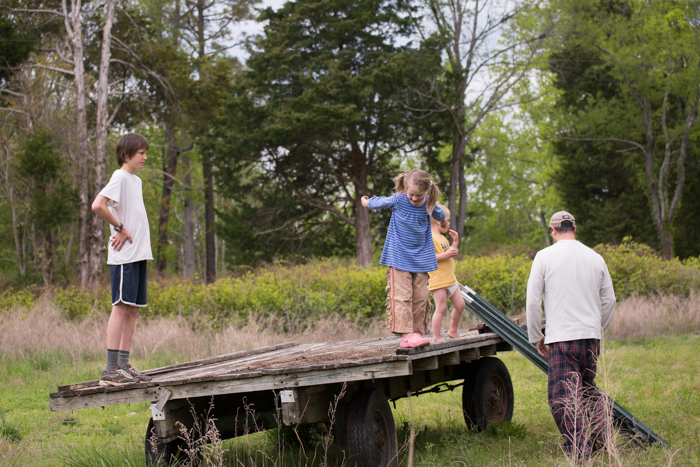
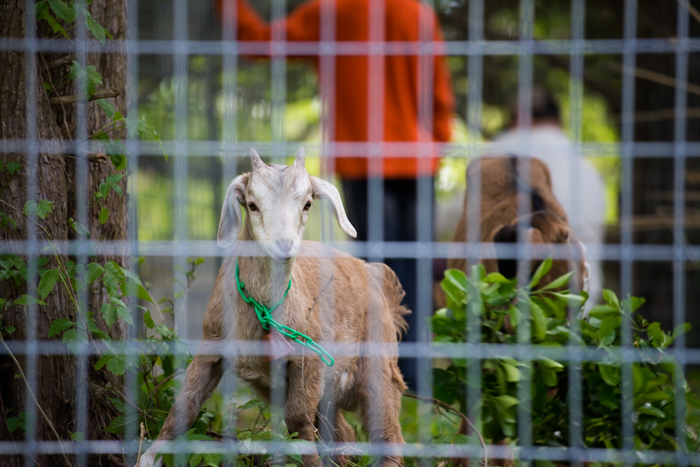
We’ve been toying with another solution in our minds for a couple of years. Yesterday, we watched it come to life after our local farm store delivered six 16-foot fence panels that we plan to use as portable fencing for our goats. Our LaMancha does, Agnes and Greta, will eventually be living in a permanently fenced area, but Little John and Robin Hood will move around our property within the portable fencing panels, clearing each space of brush and poison ivy before we move them to the next spot. They quickly devoured nearly every last bit of poison ivy in the area we fenced off for them yesterday, making us hopeful that our plan is a good one.
While I sometimes worry that Jonny and I are possibly too old-fashioned, too stuck in the past, this is one time when I do believe that using an older method for brush control might actually put us on the cutting edge. While I realize that goats aren’t the answer to the giant problem posed to conventional farmers by the growing concerns over the safety of Roundup, they may just be the chemical-free Roundup of the future in some applications, such as ours. Even Amazon.com is now offering goat rentals for brush clearing in some parts of the country, with plans to expand. Who knows, maybe one day we will offer our own goats for this service as well?
Oh the times they are a-changin’
I hope so. I hope that we can be a part of that change, however small our part is.

Amazing, inspiring post Ginny! I love your solution!
Goats eat just about anything! We don’t have a problem with poison ivy or anything similar so we don’t need to keep any. They are a great way to keep your unwanted plants under control. My brother and sister-in-law used to keep a few goats (I bought them as a Christmas present for them) and they milked them for years. The milk was used for making cheese as well as being drunk. Are you planning to milk your goats?
We used goats to clear our poison ivy on our farm and they did the greatest job! But we didnt realize that the oils stayed on their coats and we were handling them as usual and the whole family got the worst case of poison ivy. So make sure to not handle the goats when they are clearing the poison ivy
I wish I could have goats, though chickens are all I am allowed in my city. I applaud you for being “old fashioned” when it comes to chemicals … my fear is that many of these are causing big problems, especially for future generations. I used to get my next door neighbor’s grass cuttings to put on my gardens for weed suppression, but he started spraying weed killer (and, I mean really, what’s so wrong with dandelions?!) and just shrugged it off saying he was a “yard guy.” Now it’s back to laying down newspapers. Hope they are safer.
Can’t wait to see more goat pictures.
Love this post, Ginny. I can totally relate to a degree that means little in my current life. I hold a Bachelor of Science degree in Environmental Biology and a minor in Botany. And, now I dye yarn for a living. Go figure.
I wanted to share a story about my husband’s pet goat he had as a child. He left for school one day and returned on the bus to find that the goat had hung himself by climbing up a tree, getting caught up by his collar and losing his footing. I noticed the chains around your goats necks along with the trees within their enclosure and immediately thought of this incident. Sorry to be Debbie Downer. But, it would be so tragic if one of your beautiful goats met the same fate.
Hugs!
Jackie
Thanks, Jackie! Those are very lightweight plastic chains though, bought specifically because they break very easily. How awful for your husband and his goat. 🙁
Our dry creekbeds are cleared each year by an army of hundreds of goats. Their fences are moved farther and farther down the creek. It runs next to a busy street where everyone gets to see the goats’ progress. They do a terrific job. Each year there seems to be less for them to eat, which I think is good!
This was fascinating to read, and very timely too! I just graduated from college myself and I took a class about genetic engineering this semester. We discussed Roundup a lot when talking about plants being genetically modified with the Roundup-ready gene, and I too felt uneasy when I learned that it’s probably a carcinogen. I LOVE the solution you adopted to deal with the poison ivy! It’s definitely a lot safer and more natural. Anyway, those goats are the cutest!
Good goats! We use panels or electronet (possibly a problem if Silas or Job ran into THAT, though!) We also feed our (and the neighbors’) Christmas trees to them after Christmas – our goats strip them completely bare within a week. I completely agree with you about the Roundup – my husband’s mother died of lymphoma at 57, very possibly as a result of living on the family dairy surrounded by fields treated with herbicides and pesticides.
This was interesting to read. I sometimes feel that not using chemicals (to kill weeds, or to clean the house) is somehow “harder.” Your post shows that it doesn’t have to be…and that gives me something to think about.
On a side note: it looks like goats are good for EVERYTHING! Including featuring in pictures like these and making me very happy :). Thanks for sharing your goats with the world, Ginny.
This is good food for thought. As I mentioned on Instagram I have just sprayed a bunch of Round Up to get rid of our brambles, but I don’t feel good about it. However, having already been pitching for home schooling and bee keeping, I think my husband might put his foot down at goats!
Thankful you found a safe alternative. I grew up on a farm where Roundup was used liberally and I now live with the damage I endured thanks to it 🙁 I don’t believe I could ever be convinced now that it is helpful for any reason in any amount. How awesome of God to provide you with a solution!!!!! Thanks for sharing with us all so we can pass it on to others too.
It’s so funny, we’ve seen dozens of those goats (from Amazon) off the freeway (on the steep hills) here in Seattle eating away. Such a funny and crazy sight.
I had no idea they could eat poison ivy either, so glad you found another solution.
I loved reading this post, for so many reasons, but not least because I love reading about your goat adventures. I live in a mid-size town in the Midwest, and you can tell by looking at peoples’ lawns how much poison they use. It’s awful. I’m sure our neighbors aren’t happy about the dandelions, but I can’t get myself to use Roundup to create a lawn that looks like it could be made of plastic.
My dad grew up with goats. He claims that because he drank goat’s milk, he became immune to poison ivy. He says he could roll in and not develop an allergic reaction. Perhaps drinking goat’s milk is something to try with your Silas?
Someone told me the same thing about goat’s milk and poisen ivy!
Oh my goodness!!! I never heard of that, but it explains something that has happened in our family!! My oldest, now almost 18, had the knack of coming down with multiple rounds of poison ivy each year since we moved to our current house (almost 9 years ago). For the first 4 years, spring and summer, poison ivy on her ankles/feet or wrists/arms. Then year 5 she had one episode. Since then, she has not had ANY poison ivy outbreaks. Here is the kicker, we got goats one year after moving here. They were babies, so it took another year before we bred them, and another 6 months before we were drinking their milk. I couldn’t figure out why my daughter wasn’t having her annual run in with poison ivy…not that I was minding!, but this theory could explain it.
I would also like to add that the homeopathic remedy, rhus tox, is made from poison ivy, and if you or your child has a classic case of it, it should help to clear it up. Definitely better than steroids.
Blessings,
Kerri
I live in a suburban neighborhood but every summer I ask my neighbor to let his chickens “free range” in my yard. I had grubs in my numerous shady gardens for years but those chickens keep the gardens clear of any grubs. And, they are fast. I will have to let my neighbor know about the goats.
I have friends who raise goats, and they’ve told me many times that if you ever want to see a goat smile, just feed it some poison ivy. Your goats seem to have permanent smiles! I’m sure they are very happy being part of your beautiful family.
Will the poison ivy come back, since the roots are still there? I don’t like a lot of pesticides either, but poison ivy to some is very serious. The year we bought our farm (45 years ago) we cleared trees piled burned brush, It was winter, but got in my eyes from the smoke. It was awful. Carrying firewood in that has had poison ivy on it gave it to me. I have since had in my eyes again. Had to have steroid shots. So I do use sparingly on just a couple leaves of poison ivy if where I think I could get. Maybe not ideal but can be very serious if in eyes. It’s hard to know what to do. We ran a dairy for 40 years and it is very difficult to always know what to do. Blessings to you
I love it!! And that is too funny that you can rent goats through Amazon – who knew??!!
I love this! Hooray for goats and creative thinking.
I have a friend whose father was a corn and soybean farmer in Iowa. He thought Roundup was great and used it extensively in his fields. He died of liver cancer, which the doctors think was caused by Roundup toxicity. Not going there. Our goats and a high-wheeled mower take care of our place.
I grew up in the seventies (dating myself here….) and my dad back then was against chemicals and used only only as a last resort. I have poison ivy throughout my property and we leave it alone, however we do not have a toddler running naked through it so I think your goat solution is a very eco friendly solution out there. Yay!
That’s so cool! I didn’t know goats could eat poison ivy. This might be a dumb question, but does that affect their milk in any way?
I’d totally rent goats instead of Round-up. I hate chemicals and how “safe” everything is when it’s clearly not.
Hire-a-goat in place of Roundup. Yes! I’m in, also I’m sure a goat is actually cheater tahn RoundUp. At least here in Denmark this thing sells at an atrocious price, and I’m surprised people buy it. I won’t for the same reason as you.
That should have read: “is actually cheaper than RoundUp” (♪♫♪ Remember it’s the keyboard that’s bad, don’t put the blame on me ♪♫♪)
Yes to the four legged mowing machines! Our two kids arrive this weekend, Ginny! So happy to have them help clear our brush before the pigs clear the roots so we can seed pasture for the sheep! Currently, we are moving my small fibre flock of sheep around our acreage and it is brilliant…I think we can actually sell our lawn mower now! And speaking of fibre sheep……I dream of pokeweed here in British Columbia ~ the colours it creates are stunning! Funny how a weed in one place is desired in another.
I’m grateful you have turned your back on Round-Up! 🙂 Go, Goats, Go!
xo Jules
Facinating, thank you. I listened to a wonderfully informative radio documentary about ‘Monsanto’…scared me to death. Thank you for such an enlightening post.
Hi Ginny
Who knew? Goats and Poison weeds?
I know one thing for sure you are professional photographer and a pro writer. Love reading your articles –
Love B.
I second your feelings – and we do not use roundup here. I am happy you’ve found a solution! My oldest is highly allergic, and I haven’t yet – he knows what to look for & we aren’t overrun with it.
And I’m sure you already know this but I will mention it just in case (without reading through the comments) – Silas can still get it from touching the goats (and dog, cats, whatever). He can get it from any of the other children’s clothes that have touched it and haven’t been washed. I learned the hard way & I hope to save you from that!! 🙂
Wow, my eyes have been opened. When I first looked at your photos I couldn’t help but think of how destructive goats are and wondered why anyone would wan them in their yard. I couldn’t imagine letting loose a goat in my small city yard and watch it eat up all my beautiful trees and shrubs and plants. We live in Utah though, where rain is little and plants are hard enough to keep alive. I hadn’t thought about all those states that have an abundance of unwanted foliage and harmful foliage. What a great plan for natural weed control. Thanks for your informative post. Beautiful pictures also!
Great going! I too like to use organic methods as much as possible and have good luck with vinegar( in a spray bottle), and salt ( I poured this into the middle of those pesky thistles that pop up everywhere, and it dried the plant up!) I love your idea of the goats and wished we lived closer so you could drop them off for the day 🙂
Wow, those kids are growing up fast! (And so are the baby goats.)
We are just starting with goats (Lamancha’s) & Dorper sheep (nonselective grazers). Our daughter is also very allergic to poison ivy. I didn’t know that goats would eat it!! I am so glad that you shared this!
as i mentioned in the comments when you first got the goats,i raised goats for 4-H while growing up in the 1970’s.i lived in a rural township,in a small village,at the foothills of the catskill mountains in upstate new york.we only owned a half acre property,but some of our neighbors had larger parcels,and we were bordered by woods between us and the village proper on one side,and acres of woods and pastures as far as the eye could see in the opposite direction.there was plenty of brush for the goats to clear,on our property and the neighbors.we had a system down after a few years,as to the rotation order of which neighbor’s property was due for a munching on next,lol! all it took was the first spring and summer of watching our land get stripped down for the phone calls to start-“would you mind letting your goats come down into my back parcel this fall? or maybe in the spring?” the goats were never without a place to roam and chew to their hearts content.in fact,it motivated one neighbor to invest in his own herd! your flock will clear out anywhere you put them.just make sure you check your goat books for plants that they are not supposed to ingest,and keep your eyes peeled for them.there are garden plants,like azalea,that are deadly to them,but there are also wild plants,like pokeweed and chokecherry,that are equally deadly to goats.we had to be careful,and we were lucky to have very little to worry about in our area.
The poisonous plants are my biggest worry, and I’m keeping my eye out for those that would harm the goats. I’m so thankful that I’ve never liked azaleas, so we don’t have any! Pokeweed though, I’ll have to be on top of that one.
Here in southeastern Massachusetts having goats come and eat your poison ivy has become the “in” thing. You are officially trendy.
I never knew that about Mangos – my youngest only has to look at ivy and breaks out in a rash. We have prescription cream at the ready. He tried a mango for the first time this past weekend and got rashy around his mouth. I thought he was allergic to the fruit now I am wondering if he just ate too close to the peel.
I thoroughly enjoy your blog and look forward to reading and seeing your beautiful photos. Have a lovely day.
Yea Goats… I am very allergic of poison Ivy. Last year I was on steroids for 3 months trying to get rid of the rash. Which the steroids in pill form gave me a burning rash. I had topical and injection of steroids….. so yea for goats eating it…… love your stories and pics
There’s a Curious George episode I think the kids will enjoy called “George and Ally’s Lawn Service” It’s about goats eating poison ivy. I know y’all don’t watch too much t.v. but it’s a super cute episode 🙂
that is so cool about the goats eating the posion ivy! i love it. personally i think even large scale opperations could use goats to manage some plant pests, but i think it doesn’t always work well for the chemical companies if they do.
I’m rooting for the goats! This brings back vivid memories of growing up on a poison ivy-covered property in Ohio. My dad spent countless hours clearing the brush and gradually burning it, and someone always seemed to have a rash somewhere even though we all developed at least some immunity to the stuff just from being around so much of it. I always wore long pants for walks around the property, even in the summer, and learned to leave my “hackaround” shoes in the mudroom and shower off after every walk. It is a beautiful plant, though.
The Bible camp my husband attended as a child used goats to control poison ivy. He said that if you touched the goats it was like touching the ivy. He thought the poison came out through their skin or maybe it was just them rubbing up against the plants. Who knows? Just thought I’d throw that out there so little Silas doesn’t get an accidental exposure from petting those goats.
Hi Ginny,
We used this service in Atlanta. Maybe you can start something like this for DC with goats?
http://www.eweniversallygreen.com/
Great idea! I had goats growing up, and found out the hard way that, while they eat the poison ivy, the oils from the poison ivy can get on their coats, and then can rub off on your skin. I got a rash a couple of times after picking up (goat) kids that had been mowing through poison ivy even though I didn’t go near the plants themselves. It is amazing, though, what they’ll eat (or get into)!
I think this is a great idea and I hope it works well. We are so adverse to using any chemicals where our children or animals spend their time. We live in a residential area of our city on 1/5th acre, and it’s the desert so most of our property is xeriscaped, but we do have a patch of grass in the backyard just big enough for a swingset. We moved here with a 3-year-old and an infant, and I was afraid to put them in the grass that first year because the previous owner used a lawn service for this tiny patch of grass and we had no idea what may have been put on it. We just weed it, and our planter beds, by hand. Our chickens de-thatch it for us when they look for grubs. We water according to the city regs and it’s really nice grass! Poor Silas with his allergy. I’m very allergic to poison ivy too, was even hospitalized with it once as a kid. It’s no joke. I hope the goats fill right up on that poison ivy!
I am surprised that poison ivy does not affect the goats as well? I think the way you have handled the problem though it a great way and the right way!
I know! It’s so crazy to watch them eat it!!
Roundup contains neonicotinoids which cause bee death and loss of whole hives everywhere.
Hi Willie! I’m certainly not defending Roundup here, but actually the neonicotinoids are a class of insecticides, and yes definitely bad for our bees, but not part of any herbicides such as Roundup.
A friend used goats to clear his property of poison ivy, and other brush, back in 1998. Four years ago, the university where I work brought in rental goats to clear a hillside below one of the campus’ buildings – they termed it a low-carbon footprint solution. As someone who’s super susceptible to poison ivy, sumac, oak (I get it from my cats/dogs), I love your solution. Plus they’re so cute!
those are the happiest looking goats I’ve ever seen!
I learned something new with my morning cup of coffee! Thank you!
I just read one of those “pass it on” posts on Facebook about a natural “Roundup” using something like a combo of vinegar and something else. I strongly dislike roundup. Although, I dislike more the really poisonous stuff that will kill my children if they drink it that they use in our area to kill unwanted (also deadly) mushrooms/fungus. You can only control your own property unfortunately. And this is just one more reason to get wonderful goats. 🙂
My husband and my oldest son are “steroid shot” allergic to poison ivy as well. It really stinks. Luckily there is no poison ivy here…
Just to let you know, the inside of the skin of a mango has the same poison as poison ivy. My husband found this out when he didn’t want to “waste” the last bits of the mango and decided to scrape out the insides with his teeth. Next day, poison Ivy type rash all around his mouth. Poor guy. he learned his lesson. 🙂
Lastly…. are y’all milking your goats, are they milk goats? You haven’t mentioned it yet (or I might have missed it), so I’m just wondering.
We plan to breed Agnes and Greta this fall, and start milking next spring! Thanks for that tip about mangoes! I would have never guessed!
This is so interesting! Thank you so much for sharing the story, the photos are amazing but with the story as well this is one of the best blogs I’ve read for a long time. Have a wonderful day!
Your photos make poison ivy look beautiful!
Also, my friend “cured” herself from her poison ivy sensitivity by drinking goats’ milk when they had been eating the plant. She used to react horribly, and hasn’t had any reaction to it since she drank that good milk.
Are you going to be milking these beauties?
You go, guys! I applaud your efforts.
I just have to say that your writing is a ray of sunshine in my day. May the good Lord bless you and yours always.